Haven't been able to post much lately—personal stuff. For my two regular readers: here's the CES recap, finally.
CES 2026 ran January 5-8 in Las Vegas. Obviously I wasn't there—who has that kind of money. This is based on PC Gamer, Tom's Hardware, Engadget coverage, and the official stream archives. Some of this overlaps with stuff I've written about before (the memory situation, Nvidia's priorities), but here's everything in one place.
Short version: Nvidia announced no new GPUs. AMD talked about AI laptops. Intel showed integrated graphics that might actually matter. Everything else was concept robots and brain-wave headsets.
Nvidia
They tweeted before Jensen's keynote: "No new GPUs will be announced."
First time in seven years they've done this. No RTX 5080 Super. No 5070 Ti. The RTX 50 series from late 2025 is apparently all we're getting this year.
DLSS 4.5 brings 6x Multi Frame Generation. One real rendered frame, six interpolated frames. They're marketing this as "4K 240Hz path-traced gaming."
Technically, that's accurate. Whether it feels like 240Hz when only one in seven frames represents actual game state—I have doubts. Frame generation already introduces input latency and temporal artifacts at 2-3x. At 6x, you're watching a prediction engine more than playing a game. But I haven't tested it personally, so I'll wait for Digital Foundry.
G-Sync Pulsar: Variable frequency backlight strobing. PC Gamer's Jacob Ridley tested it and said it "kinda ruined all other gaming monitors for me." Four 27-inch 1440p 360Hz panels launching—ASUS ROG Swift PG27AQNP, Acer Predator XB273U F5, AOC AGON PRO AG276QSG2, MSI MEG 271Q. $600-750.
The limitation: only works with RTX 50 series cards.
Rubin: Data center platform. Not relevant here.
As I've said before—HBM for AI accelerators pays 25-30x more per chip than GDDR7. Nvidia's following the money. Disappointing, but not surprising.
Intel Panther Lake
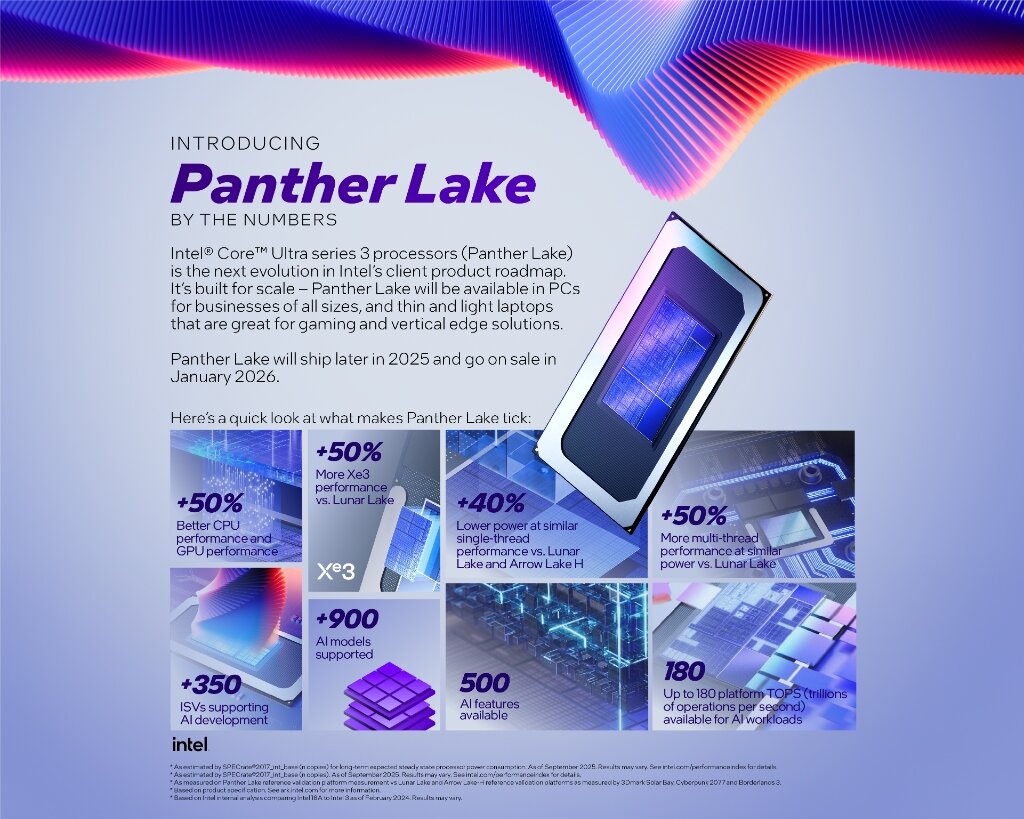
Core Ultra Series 3. Intel's first consumer chip on their 18A process node.
Core Ultra 9 388H specs:
- 8 P-cores + 12 E-cores
- Arc B390 integrated GPU, 12 Xe3 cores
- 18A process (Intel's in-house node)
Intel claims the Arc B390 iGPU is "roughly as powerful as the RTX 4050" mobile GPU. Up to 77% faster than Lunar Lake's integrated graphics.
Engadget's Devindra Hardawar got hands-on with a Lenovo IdeaPad Pro 5: Battlefield 6, 1080p high settings, 190fps. No discrete GPU.
If those numbers hold in retail units, that's significant. Intel's promised breakthrough iGPU performance before—Iris Xe was supposed to be "discrete-class" and it wasn't, really. Demo units at trade shows are hand-picked. 18A is unproven at volume. Yields, power consumption under sustained load, thermal throttling—all unknowns until laptops actually ship.
But if it works: thin-and-lights become gaming-capable without dedicated GPUs. Handhelds improve substantially. Budget laptops become viable gaming machines during the GPU shortage I keep writing about.
Q1 2026 availability. We'll see.
AMD
Lisa Su's keynote was mostly Ryzen AI 400 series laptops. "50 TOPS NPU performance" for local AI inference.
NPU compute is useful if you're running Stable Diffusion locally or using AI video editing tools. For everyone else, it's a number on a spec sheet.
Gaming announcements came at the end:
Ryzen 7 9850X3D: 8-core with 3D V-Cache. Leaked in December, confirmed at CES. No performance benchmarks yet. Q1 2026.
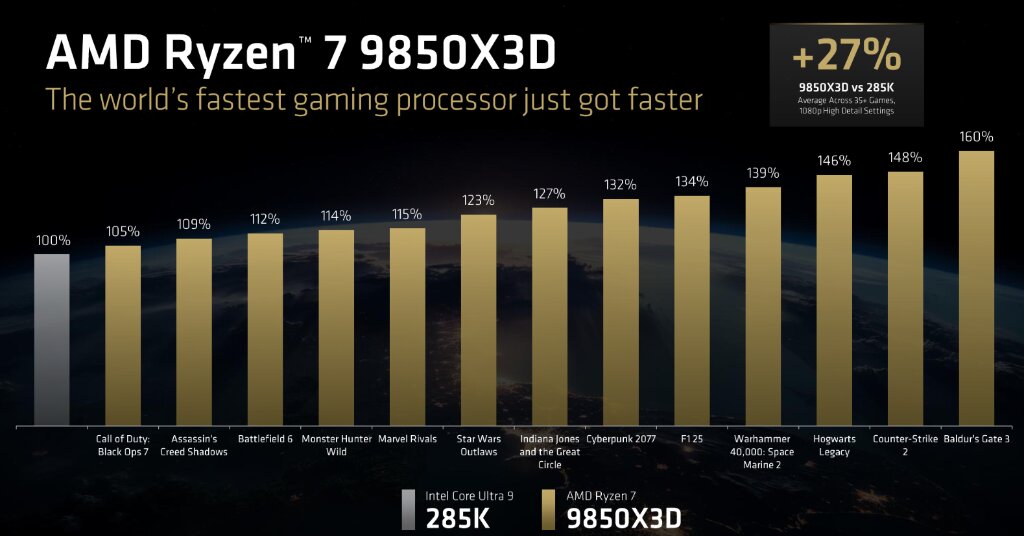
Ryzen 9 9950X3D2: Not officially announced, but AMD partners listed it in PC configs before AMD said "stay tuned." Dual-chiplet with V-Cache on both dies. PC Gamer's Jacob Ridley was skeptical about gaming benefits—cross-chiplet latency is a real concern unless games optimize for it specifically.
No new GPUs. RX 9070 XT from late 2025 is apparently the lineup for now.
Memory Shortage
I've covered this extensively already, but it's worth repeating: the memory situation explains everything about CES 2026.
- Nvidia: no consumer GPU updates (first time in 7 years at CES)
- AMD: no GPU announcements
- SSDs/RAM: minimal new products
- SanDisk: announced doubling 3D NAND prices for enterprise SSDs in Q1
Jensen spent an hour on Rubin platforms using HBM4. Lisa Su spent most of her time on AI laptops. Same pattern as before—AI infrastructure gets priority, consumers get leftovers.
Monitors
Actual products shipping Q1-Q2:
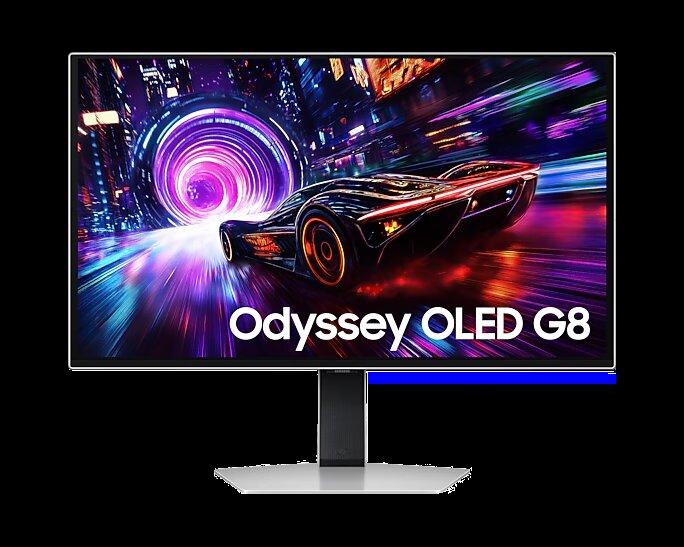
Samsung Odyssey OLED G8: 34-inch, 360Hz, QD-OLED. New RGB stripe subpixel layout that addresses text clarity issues from previous OLED generations. ASUS, MSI, Gigabyte announced panels using the same tech.
LG 39-inch 5K2K OLED: 5120x2160, curved, 240Hz native (or 480Hz at 1080p). PC Gamer called it "easily my favourite new PC monitor at CES 2026."
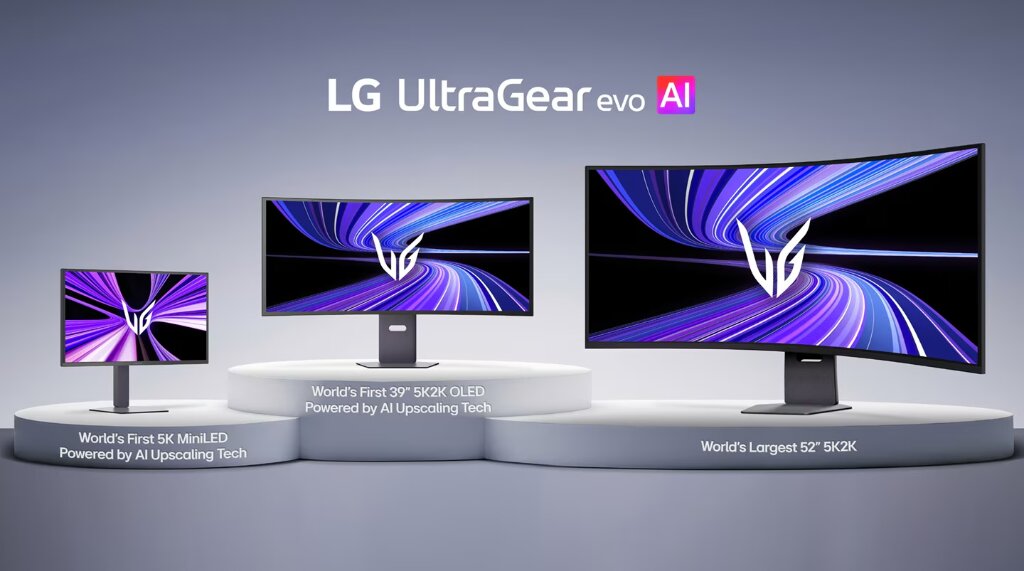
Both in the $800-1200 range. These are real products with shipping dates, not concepts.
Laptops and Handhelds
ASUS ROG Zephyrus Duo (2026): 16-inch dual-screen. Two 3K OLED displays, detachable keyboard, up to RTX 5090 mobile. First of its form factor at this size.
Lenovo Legion Go 2 (SteamOS variant): $1,199, June 2026. A major OEM shipping SteamOS on a handheld that isn't a Steam Deck. Relevant for Valve's ecosystem expansion.
Concept Products
LG CLOiD: Humanoid robot that loads washing machines. Every outlet called it "star of CES." It's a prototype video with no release date.
Razer Project Motoko: AI camera headset. Concept.
HyperX x Neurable: EEG headset for brain-wave monitoring. Unclear if functional or marketable.
Recommendations
For anyone planning builds or upgrades:
Wait for Panther Lake reviews before buying thin-and-light laptops. Intel's claims are compelling but unverified in retail hardware.
GPU prices aren't dropping. Memory shortage continues into 2027 according to TrendForce forecasts. Current RTX 50 series is the lineup for 2026.
OLED monitors are worth watching. Samsung and LG's 2026 panels address the text clarity complaints that kept people on IPS. If you've been waiting for OLED to mature, this is probably the year.
Ignore "AI-powered" unless the feature does something you actually need. Marketing teams discovered AI sells. Most implementations are spec sheet padding.
CES 2026 was disappointing for PC hardware. A few good monitors, one potentially strong iGPU launch from Intel, confirmation that Nvidia and AMD prioritize data center revenue over consumer products. The memory shortage isn't ending soon.
If Panther Lake works as demoed, portable gaming gets better. If Samsung/LG's panels deliver, OLED monitors finally become practical for desktop use. Everything else was AI hype and prototypes.
Sources: Nvidia/AMD/Intel CES 2026 keynotes; PC Gamer (Jacob Ridley, Wes Fenlon); Tom's Hardware; Engadget (Devindra Hardawar); manufacturer announcements; SanDisk pricing communications