
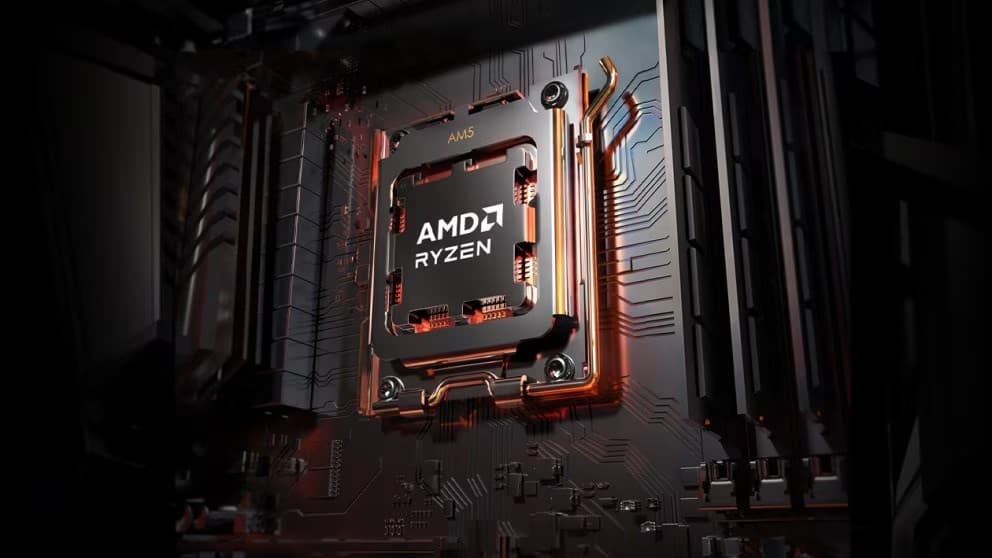
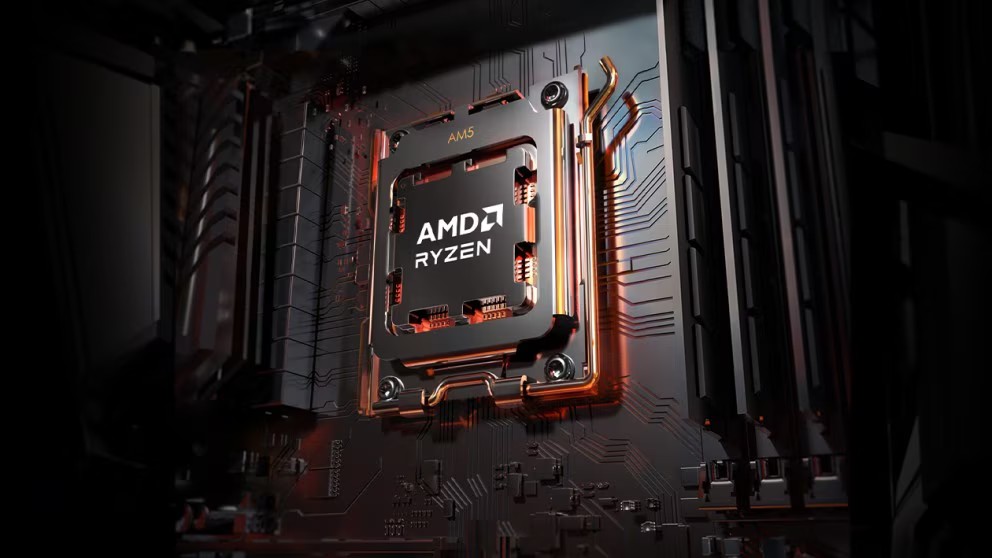
AMD's rumored flagship gaming CPU, the Ryzen 9 9950X3D2, has surfaced in Geekbench and PassMark benchmark databases, marking the first appearance of what could be the company's most cache-dense consumer processor ever made.
The Leaks
On December 26, 2025, two separate benchmark listings appeared online showing a processor identified as the AMD Ryzen 9 9950X3D2:
PassMark Results:
- Multi-core score: 71,585
- Single-core score: 4,716
Geekbench 6 Results:
- Multi-core score: 21,062
- Single-core score: 3,456
The Geekbench listing shows the CPU running on a Galax B850M motherboard (which hasn't been officially released yet) with 96GB of DDR5-4800 memory.
Specifications: 192MB of L3 Cache
According to the benchmark listings and previous leaks, the Ryzen 9 9950X3D2 features:
- 16 cores / 32 threads
- Base clock: 4.3 GHz
- Boost clock: 5.6 GHz (100 MHz lower than the 9950X3D's 5.7 GHz)
- L3 cache: 192MB (64MB more than the current 9950X3D)
- TDP: 200W (up from 170W on the 9950X3D)
The "X3D2" designation appears to indicate dual 3D V-Cache stacking—meaning both CCDs (chiplets) will have 3D V-Cache, rather than just one as in current Ryzen 9 X3D models.
Cache Breakdown:
- CCD 1: 64MB 3D V-Cache + 32MB on-die cache = 96MB
- CCD 2: 64MB 3D V-Cache + 32MB on-die cache = 96MB
- Total: 192MB L3 cache
This would make the 9950X3D2 the first mainstream desktop CPU with 3D V-Cache on both chiplets.
Performance: Modest Gains in Synthetic Tests
The leaked benchmark scores show the 9950X3D2 performing within the margin of error of the existing Ryzen 9 9950X and 9950X3D in both PassMark and Geekbench.
Tom's Hardware noted:
"Both of those numbers are within the margin of error of the 9950X and 9950X3D, but a bit far from the highest-scoring CPUs on the database."
HotHardware added:
"The Passmark result confirms that the 'X3D2' part doesn't seem to lose any performance versus the currently available part. The peak boost clock appears to be 100 MHz lower, at 5.6 GHz instead of 5.7 GHz, but the actual effect that has on the chip is a margin-of-error difference."
Why Synthetic Scores Don't Tell the Full Story
The relatively modest performance in CPU benchmarks is expected. The real advantage of 3D V-Cache isn't raw compute power—it's cache-sensitive workloads, particularly gaming.
Guru3D explained:
"Synthetic benchmarks only tell part of the story. The results suggest that AMD has refined its Zen 5 X3D implementation rather than introducing major architectural changes. More details are expected closer to the official announcement."
Wccftech noted:
"Since this is a synthetic workload which showcases the ST/MT capabilities, & not the gaming performance, the scores are to be expected since the 9950X3D2 should be clocked 100 MHz lower. As such, the main difference won't be the app performance but rather gaming performance, and that too in certain cases where games can utilize the extra cache."
The dual-cache design could eliminate the thread scheduling problems that plague current dual-CCD X3D processors. Currently, Windows needs to intelligently schedule game threads to the CCD with 3D V-Cache, which doesn't always work perfectly. With cache on both CCDs, this issue disappears.
The Ryzen 7 9850X3D: A Higher-Clocked Companion
The 9950X3D2 isn't the only X3D refresh AMD is preparing. The Ryzen 7 9850X3D has also appeared in benchmarks and retail listings.
Expected Specifications:
- 8 cores / 16 threads
- Base clock: 4.7 GHz
- Boost clock: 5.6 GHz (400 MHz higher than the 9800X3D's 5.2 GHz)
- L3 cache: 96MB (same as 9800X3D)
- TDP: 120W (same as 9800X3D)
The 9850X3D represents a binned, higher-clocked version of the existing Ryzen 7 9800X3D, which has been AMD's best-selling gaming CPU.
PassMark results show the 9850X3D achieving approximately 5% better performance than the 9800X3D in both single-core and multi-core tests. Compared to the previous-generation Ryzen 7 7800X3D, the 9850X3D shows over 20% improvement.
AMD's Official Confirmation (Sort Of)
While AMD hasn't issued a press release, the company accidentally confirmed the Ryzen 7 9850X3D by listing it on its official driver support pages in early December 2025.
The listing was spotted by dataminer Olrak29 on AMD's French driver website. While no specifications were provided, the mere presence on an official AMD page strongly suggests the chip is real and nearing launch.
VideoCardz noted:
"AMD itself has briefly exposed the Ryzen 7 9850X3D on its driver pages, confirming that there is an update to company's best selling gaming CPU coming soon."
The Ryzen 9 9950X3D2, however, has not appeared on any official AMD pages, leaving its status more uncertain.
Expected Announcement: CES 2026
AMD CEO Dr. Lisa Su will deliver the opening keynote at CES 2026 on Monday, January 5, 2026, at 6:30 PM PT in Las Vegas. The presentation is officially focused on AMD's AI strategy, but industry observers expect gaming hardware announcements as well.
Digital Trends reported:
"The Ryzen 7 9850X3D is one chip that is likely to make an official appearance at CES 2026. The chip was accidentally revealed by AMD itself through its own driver pages, which itself hints that the CPU is ready for launch."
Whether the Ryzen 9 9950X3D2 will be announced at CES or launched later in 2026 remains unclear. The chip has not appeared in retail listings yet, unlike the 9850X3D which has been spotted at Swiss and U.S. retailers.
Analysis: Is Dual-Cache Worth It?
The Ryzen 9 9950X3D2 addresses a long-standing limitation of dual-CCD X3D processors: cache asymmetry.
Current 16-core X3D chips like the 9950X3D place 3D V-Cache on only one of the two 8-core chiplets. This creates scheduling challenges—Windows and game engines must intelligently route gaming workloads to the "fast" CCD while keeping background tasks on the "slow" CCD.
It doesn't always work perfectly, resulting in inconsistent gaming performance on 16-core X3D chips compared to the simpler single-CCD 8-core models.
By placing 3D V-Cache on both CCDs, the 9950X3D2 theoretically eliminates this problem entirely. All 16 cores have equal access to massive cache, removing scheduling overhead.
Pros:
- No thread scheduling issues
- Highest L3 cache ever on a mainstream desktop CPU (192MB)
- Better performance consistency in cache-sensitive workloads
- All cores benefit from V-Cache
Cons:
- 100 MHz lower boost clock (5.6 GHz vs 5.7 GHz)
- 30W higher TDP (200W vs 170W)
- Likely higher price
- Most games don't scale well beyond 8 cores anyway
HotHardware explained:
"People have been hoping for a Ryzen 9 processor with V-Cache on both CCDs for some time despite the somewhat questionable merits of such a processor. In terms of consumer workloads, gaming is the only thing that really benefits from the extra cache, and a single-CCD configuration with one stack of 3D V-Cache is typically the best performer in that arena."
For pure gaming, the 8-core Ryzen 7 9800X3D (or the upcoming 9850X3D) will likely remain the better choice. The 9950X3D2 targets users who need both heavy multithreaded workloads (video editing, 3D rendering, compiling) and gaming performance without dealing with Windows scheduler quirks.
Pricing and Availability: Unknown
AMD has not announced pricing or release dates for either chip.
For context:
- Ryzen 7 9800X3D: $479 MSRP (currently sold out in most regions)
- Ryzen 9 9950X3D: $689 MSRP
- Ryzen 9 9950X: $649 MSRP
The Ryzen 7 9850X3D will likely slot in at $499-$529, positioning it as a premium version of the 9800X3D.
The Ryzen 9 9950X3D2's pricing is harder to predict. The dual-cache design adds manufacturing complexity and pushes TDP to 200W, which could justify a price above the current 9950X3D's $689. A $749-$799 price point seems plausible, though AMD may price aggressively to compete with Intel's upcoming Arrow Lake Refresh.
The Broader Context: AMD's Gaming Dominance
AMD's X3D processors have dominated the gaming CPU market since the Ryzen 7 5800X3D launched in 2022. The current Ryzen 7 9800X3D, which launched in November 2024, has been in near-constant shortage due to overwhelming demand.
Neowin noted:
"In the current state of PC affairs, those who want to get the best gaming performance with the latest hardware should opt for AMD processors with stacked 3D V-Cache."
Intel's competing Arrow Lake processors (Core Ultra 200 series) have struggled to match X3D gaming performance, particularly in 1080p and 1440p scenarios where CPU performance matters most.
The 9850X3D and 9950X3D2 represent AMD doubling down on its X3D advantage ahead of Intel's expected Arrow Lake Refresh in early 2026.
Conclusion
The Ryzen 9 9950X3D2 and Ryzen 7 9850X3D represent a "soft refresh" of AMD's Zen 5 X3D lineup rather than a revolutionary leap.
The 9850X3D is straightforward: take the best-selling 9800X3D, increase boost clocks by 400 MHz, charge a small premium. Expect modest (5-10%) gaming performance gains in CPU-limited scenarios.
The 9950X3D2 is more interesting architecturally. Dual 3D V-Cache on both CCDs solves real scheduling problems and pushes total L3 cache to unprecedented levels. But the practical gaming benefits remain unclear—most games still favor the simpler 8-core design.
Both chips are expected to be officially announced at CES 2026 on January 5, 2026, though launch dates and pricing remain unknown.
For gamers, the Ryzen 7 9850X3D will likely be the more compelling option—if you can find one in stock.
Sources: Tom's Hardware, Wccftech, HotHardware, VideoCardz, Lowyat.NET, Neowin, Guru3D, The FPS Review, Digital Trends, WebProNews. Benchmark data verified through multiple independent sources.