
Author's Note: I've been away for a few days—work got overwhelming and I couldn't find time to write. This piece is different from what I usually do. Normally I'd be pointing out corporate spin, adding commentary, finding the angle. Not this time. I spent most of a night reading GDC survey data, tracking layoff numbers across five different industry trackers, and pulling stock charts. I don't have a hot take. The data is complicated—45,000 layoffs happened while AI adoption stayed flat, developer sentiment tripled against AI, and then Unity crashed 24% on a single product announcement. I wrote this to document what happened, present the alternative explanations, and be honest about what I don't know. If you want opinion, I don't have one. If you want receipts, keep reading.
TL;DR: Unity's stock dropped 24% after Google launched Project Genie, an experimental AI that generates 3D game environments. The selloff happened amid 45,000 gaming layoffs (2022-2025) and developer sentiment turning sharply negative on AI (52% now think it's harmful vs. 18% in 2024). Whether AI adoption caused the layoffs, and whether Project Genie threatens Unity's business, remains unclear from available data.
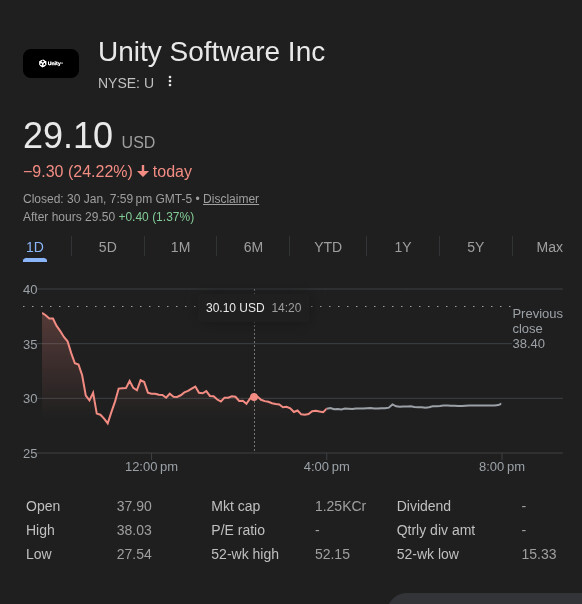
On January 29, 2026, Google launched Project Genie—an experimental AI tool that generates interactive 3D environments from text prompts. By Friday's market close, Unity's stock had dropped 24.2%, Take-Two fell 9%, and Roblox declined 12%.
Project Genie has documented limitations. Google states it "is not a game engine and can't create a full game experience." Sessions last 60 seconds maximum, output caps at 720p/24fps, and it cannot create game mechanics or scripting.
This investigation examines three documented trends: layoffs (45,000 gaming jobs lost since 2022), AI adoption (52% of studios use generative AI), and shifting developer sentiment (52% think AI harms the industry, up from 18% in 2024).
PART I: THE STOCK SELLOFF (JANUARY 30, 2026)
What Happened
Unity Software (NYSE: U):
- January 29 close: $38.40
- January 30 after-hours: $29.10
- Decline: 24.2%
Take-Two Interactive (NASDAQ: TTWO):
- Decline: 9% intraday
Roblox Corporation (NYSE: RBLX):
- Decline: 12% intraday
AppLovin, Nintendo ADRs, and Tencent ADRs also declined.
What Project Genie Actually Does
According to Google's official documentation and demo:
- Generates interactive 3D environments from text prompts or uploaded images
- Runs at 20-24 frames per second
- Sessions limited to 60 seconds
- Output resolution: 720p maximum
- Allows real-time exploration with customizable avatars
- Powered by Genie 3 world model
- Available to Google AI Ultra subscribers ($250/month)
What It Can't Do
Google's spokesperson told The Register:
"Project Genie is not a game engine and can't create a full game experience."
Documented limitations:
- No game mechanics (scoring, objectives, progression)
- Poor text rendering (can't create UI)
- Inconsistent physics simulation
- Cannot create scripting or logic
- 60-second session maximum
The Technical Threat Question
Project Genie's current limitations are significant. But the relevant question for Unity's stock price isn't "Can Genie replace Unity today?" It's "What happens if these limitations disappear?"
Scenario 1: Session limits extend
- Currently: 60 seconds
- If extended to 10-15 minutes: Could support meaningful exploration
- If extended to hours: Could support game-like experiences
Scenario 2: Mechanics generation arrives
- Currently: No objectives, scoring, or progression
- If added: Could create simple game loops (collect items, reach goals)
- Combined with extended sessions: Could approximate casual games
Scenario 3: Logic/scripting capabilities
- Currently: No conditional logic or player consequences
- If added: Could create interactive narratives with branching
- Combined with mechanics: Could approximate adventure games
Timeline uncertainty:
- Genie 1 (2024): Couldn't generate interactive worlds
- Genie 3 (2025): Generates interactive worlds, 60-second sessions
- Genie 5 (2027?): Unknown capabilities
If improvement rate from Genie 1 to Genie 3 continues (roughly 12-18 months between major versions), extended sessions and basic mechanics could arrive within 2-3 years.
Unity's competitive position if this happens:
Unity's strength: Professional-grade physics, rendering, multiplayer networking, asset management, cross-platform deployment.
Unity's vulnerability: If "good enough" interactive experiences become accessible to non-developers, Unity's addressable market shrinks—not because professionals abandon it, but because the number of people who need professional tools declines.
This interpretation helps explain the magnitude and timing of the selloff.
Not because Genie replaces Unity today. Because investors see a plausible path where it narrows Unity's market in 2-3 years.
Analyst Responses
Dylan Becker, William Blair (via MarketWatch):
Investor worries "overlook the complexity and sophistication" of Unity's engine.
Joost van Dreunen, NYU Stern School of Business (via Reuters):
"The real breakthrough will come when AI begins crafting experiences that are uniquely its own."
Unity has scheduled Q4 and fiscal 2025 earnings release for February 11, 2026.
(Sources: TechStock², Investing.com, Reuters, The Register, MarketWatch)
PART II: THE LAYOFFS (2022-2025)
The Numbers
According to industry trackers (Wikipedia, Udonis, DigitrendZ, Gaming Amigos):
- 2022: ~8,500
- 2023: 10,500+
- 2024: 14,600+
- 2025: 9,175
- Total: ~45,000
Breakdown by Role
According to the GDC 2026 State of the Game Industry survey (2,300+ respondents):
- 28% of all developers: laid off in past two years
- Game designers: 20% laid off in last 12 months
- Narrative roles: 19% laid off
- Business operations: 8% laid off
Major Companies
Microsoft Gaming:
- ~9,000+ layoffs in 2025
- Closed The Initiative studio
- Cuts across Activision Blizzard, Bethesda, Xbox teams
Unity Technologies:
- 1,800 layoffs in 2024
- Closed 23 offices
- Additional layoffs February 2025
Ubisoft:
- 1,500+ employees (Nov 2023-Sept 2025)
- Headcount: 18,597 (Sept 2024) → 17,097 (Sept 2025)
Electronic Arts: 485 roles
Sony Interactive Entertainment: 85+ roles
Take-Two, Amazon Games, Square Enix: Documented layoffs (specific numbers vary by source)
Companies' Stated Reasons
When GDC survey respondents were asked why they were laid off, they reported companies told them:
- 22%: "Restructuring"
- 18%: "Declining revenues"
- 15%: "Market or industry shifts"
- 19%: No reason given
- 26%: Other reasons
(Sources: Wikipedia, Udonis, DigitrendZ, Gaming Amigos, GDC 2026 survey, Game World Observer)
PART III: AI ADOPTION DATA (2024-2026)
GDC Survey Results
The Game Developers Conference conducts an annual State of the Game Industry survey. AI sentiment data:
- 2024: 52% using AI, 18% think negative, 21% think positive
- 2025: 52% using AI, 30% think negative, 13% think positive
- 2026: 52% using AI, 52% think negative, 7% think positive
Sentiment by Role
According to GDC 2026, percentage who think AI is bad for industry:
- Visual and technical artists: 64%
- Game design and narrative: 63%
- Game programming: 59%
- Executives: 19% (think AI is positive)
- Business operations: 19% (think AI is positive)
Tools Being Used
GDC 2026 respondents reported using:
- ChatGPT: 74%
- Google Gemini: 37%
- Microsoft Copilot: 22%
- Proprietary services: 21%
- Midjourney: 17%
Developer Comments
From GDC 2026 survey open-ended responses:
"No matter how you put it, generative AI isn't a great replacement for real people and quality is going to be damaged."
"I think AI generated code is currently low quality, and can give rise to subtle bugs that the person using the AI doesn't understand."
"People will end up having to review generated content rather than create things themselves, which is not what we all get into the industry for."
"The market will become oversaturated with low effort or AI created projects, content, and games that are put out to make money."
One GDC survey respondent identified as working in machine learning operations wrote:
"We are intentionally working on a platform that will put all game devs out of work and allow kids to prompt and direct their own content."
This quote appeared in The Register's coverage of Project Genie. The respondent's employer and specific role are not identified in published GDC survey data.
(Sources: GDC 2025 & 2026 State of the Game Industry surveys, Game Developer, GIANTY, The Register)
PART IV: CASE STUDY—UBISOFT'S COLLAPSE
Why this matters: Ubisoft's trajectory illustrates what happens when layoffs, technical debt, and financial decline compound. It's the clearest example of whether mass workforce reduction correlates with operational failure.
Financial Trajectory
- Jan 2021: $12.17B (peak)
- Jan 2024: $3.14B (down 74%)
- Dec 2025: ~$1.01B (down 85% from peak)
Debt vs. Market Cap (Sept 2024):
- IFRS net debt: €1.408B (~$1.48B USD)
- Market cap (April 2025): €1.366B (~$1.43B USD)
Layoffs
- Nov 2023-Jan 2025: 676 (various locations)
- Dec 2024: 277 (XDefiant shutdown)
- Jan 2025: 185 (Leamington closure)
- Sept 2025: 700 (multiple teams)
Total headcount change:
- September 2024: 18,597
- September 2025: 17,097
- Net reduction: 1,500
XDefiant Shutdown
Mark Rubin, Executive Producer, posted on June 4, 2025:
"We had very little marketing, especially after launch, we weren't acquiring new players after the initial launch."
"We had crippling tech debt using an engine that wasn't designed for what we were doing, and we didn't have the engineering resources to ever correct that."
"What we saw in Season 3 wasn't even enough content in my mind for launch."
Rubin announced he was leaving the gaming industry entirely.
Rainbow Six Siege Security Breach
December 27, 2025: Hackers breached Rainbow Six Siege backend systems and:
- Distributed premium currency (approximately 2 billion R6 Credits, ~$13M retail value)
- Unlocked developer-only items
- Hijacked ban ticker for messages
- Randomly banned/unbanned players
Ubisoft shut down all servers globally (PC, PlayStation, Xbox). As of this writing, Ubisoft has not disclosed attack vectors or confirmed compromised data.
(Sources: Ubisoft financial reports, VGC, PC Games N, BleepingComputer, Tom's Hardware)
PART V: LABOR ORGANIZING
Unionization Support
According to GDC 2026 survey:
- 82% of US-based developers support unionization
- 62% are interested in joining a union
- 10% are already union members
Highest support among:
- Workers earning under $200,000/year: 87%
- Workers laid off in past two years: 88%
- Workers under 45 years old: 86%
Ubisoft Halifax Timeline
- June 18, 2025: Workers file for union certification
- June-Dec 2025: Ubisoft challenges through "several hearings"
- December 18, 2025: Union certified (73.8% approval)
- January 7, 2026: Studio closure announced
- Time between certification and closure: 20 days
United Videogame Workers-CWA
Launched at GDC 2025. 10% of GDC 2026 survey respondents report union membership.
(Sources: GDC 2026 survey, previous Ubisoft investigation reporting)
PART VI: WHAT THE TIMELINE SHOWS
Parallel Trends
AI Adoption:
- 2024: 52% of companies use generative AI
- 2025: 52% of companies use generative AI
- 2026: 52% of companies use generative AI
Developer Sentiment:
- 2024: 18% think AI is negative
- 2025: 30% think AI is negative (+12 points)
- 2026: 52% think AI is negative (+22 points)
Layoffs:
- 2022-2025: 45,000 jobs lost
- 2026 GDC survey: 28% of developers laid off in past two years
Unionization:
- 2024: Not tracked
- 2025: Not tracked
- 2026: 82% support unions
What This Proves
These are documented correlations. They do not prove causation.
Possible interpretations:
- AI adoption caused layoffs - Companies used AI tools to reduce headcount needs
- Layoffs caused AI resentment - Developers blame AI for job losses
- Both trends share common cause - Economic conditions drove both AI adoption and cost-cutting
- No causal relationship - Coincidental timing
Available data does not conclusively support any single interpretation.
PART VII: THE STOCK MARKET REACTION
Unity's Specific Risk
Unity's business model: sell development tools to professional game developers.
The threat isn't substitution—it's demand elasticity.
If AI tools reduce the number of projects that require professional-grade engines, Unity's addressable market shrinks—even if existing professionals continue using Unity.
Example scenario:
- Today: 100,000 professionals use Unity, 0 non-professionals create games
- Future: 100,000 professionals still use Unity, 500,000 non-professionals create "good enough" experiences with AI tools
- Result: Unity's market share of total interactive content creation drops from 100% to 17%
Unity doesn't lose existing customers. But total demand for professional tools grows slower than total content creation.
Evidence of demand contraction:
- 45,000 developers laid off since 2022
- Unity laid off 1,800 employees in 2024
- Unity closed 23 offices in 2024
Whether these layoffs reflect reduced demand for professional tools or temporary cost-cutting remains unclear.
Counterargument (Dylan Becker, William Blair):
Project Genie limitations suggest Unity's sophisticated engine remains necessary for production games.
Pricing Comparison
- Unity Pro: $2,040/year ($170/month)
- Unreal Engine: Free (5% revenue share after $1M)
- Project Genie: $250/month (via Google AI Ultra subscription)
What Changed Friday
Before Friday: Investors knew AI world-generation was theoretically possible.
After Friday: Investors knew AI world-generation exists and is available to consumers for $250/month.
Whether this constitutes a meaningful competitive threat to Unity depends on:
- How quickly Project Genie's capabilities improve
- Whether Google expands session length and output quality
- Whether consumers adopt it for actual game creation
- Whether Unity can adapt by integrating AI features
None of these questions have definitive answers.
ALTERNATIVE EXPLANATION: MACRO CONDITIONS AND POST-PANDEMIC CORRECTION

A competing explanation for Friday's selloff: gaming equities were already structurally vulnerable, and Project Genie acted as catalyst rather than cause.
The Macro Case
Post-pandemic demand normalization:
- Gaming spending surged during COVID-19 lockdowns (2020-2021)
- Consumer spending patterns reverted as economies reopened
- Hardware sales declined (console sales down across Nintendo, Sony, Microsoft)
- Free-to-play revenue growth slowed
Interest rate environment:
- Federal Reserve raised rates throughout 2022-2023
- Higher discount rates compress valuations for growth stocks
- Gaming companies trade at growth multiples, making them sensitive to rate changes
- Unity particularly vulnerable (unprofitable growth company)
Revenue softness across publishers:
- Take-Two delayed GTA VI (originally expected earlier)
- EA's live-service struggles documented (Anthem, Battlefield 2042)
- Ubisoft's decline preceded AI adoption (market cap falling since 2021)
- Industry-wide challenges with game development costs rising faster than pricing power
The Catalyst vs. Cause Argument
Under this interpretation:
- Gaming stocks were already overvalued relative to post-pandemic fundamentals
- Layoffs reflected cost-cutting in response to revenue challenges, not AI preparation
- Project Genie provided a narrative hook for selling pressure already building
- The selloff would have occurred anyway—Genie just accelerated timing
Evidence supporting this view:
- Ubisoft's collapse began in 2021, before widespread AI adoption
- Take-Two and Roblox declined despite not being direct Unity competitors
- Broader tech selloff happened throughout 2022-2023
- Gaming ETFs underperformed before Project Genie launched
Why this explanation fits equally well:
The data cannot distinguish between:
- "AI tools are displacing workers and threatening business models" (AI-driven narrative)
- "Gaming companies are struggling with post-pandemic normalization and used AI as cost-cutting justification" (macro-driven narrative)
Both interpretations match the observed facts. Neither can be definitively ruled out.
What This Means
If the macro explanation is correct, Project Genie's impact was psychological rather than fundamental. Investors were already looking for reasons to sell gaming stocks; Google's announcement provided one.
Friday's selloff would then represent: market sentiment, not forward-looking valuation.
This investigation presents the AI-correlation narrative because the timing is striking (sentiment tripled from 18% to 52% while AI adoption stayed constant). But intellectual honesty requires acknowledging the macro explanation fits the data equally well.
We don't know which is correct. Possibly both contribute.
CONCLUSION: WHAT WE KNOW AND WHAT WE DON'T
Documented Facts
- Stock selloff: Unity -24.2%, Take-Two -9%, Roblox -12% (Jan 30, 2026)
- Layoffs: 45,000 gaming jobs lost (2022-2025)
- AI adoption: 52% of studios use generative AI (constant 2024-2026)
- Developer sentiment shift: 18% thought AI was negative (2024) → 52% (2026)
- Unionization support: 82% of US developers (GDC 2026)
- Project Genie limitations: 60-second sessions, no game mechanics, 720p/24fps max
- Project Genie availability: $250/month via Google AI Ultra
Open Questions
1. Did AI adoption cause layoffs? Companies cited restructuring, declining revenues, and market shifts. No company stated "We laid off workers because AI replaced them." Correlation documented; causation unproven.
2. Will Project Genie improve enough to threaten Unity? If session limits extend, mechanics generation arrives, and logic/scripting becomes possible—plausible within 2-3 years given Genie 1 to Genie 3 improvement rate—Unity's addressable market could contract significantly. Timeline and Google's roadmap unclear.
3. Was Friday's selloff justified? Depends on unprovable predictions about AI trajectories. Analysts disagree. Time will determine accuracy.
The Takeaway
Gaming stocks crashed not because Project Genie replaces professional development today, but because investors see a plausible path where AI tools narrow the professional development market within 2-3 years.
Whether they're correct requires answering questions about future AI capabilities and corporate strategies that available data cannot definitively resolve.
What's certain: 45,000 developers lost jobs while AI adoption stayed constant and developer opposition tripled. These trends are happening simultaneously, regardless of causal relationship.
The stock market appears to have priced that combination as risk.
Sources: TechStock², Investing.com, Yahoo Finance, MarketWatch, Reuters, Wikipedia, Udonis, DigitrendZ, Gaming Amigos, Game World Observer, GDC 2025 & 2026 State of the Game Industry surveys, Game Developer, GIANTY, Google DeepMind, Google Blog, The Register, Engadget, TechCrunch, Ubisoft financial reports, VGC, PC Games N, BleepingComputer, Tom's Hardware. Currency conversions use approximate €1 = $1.05 USD.