
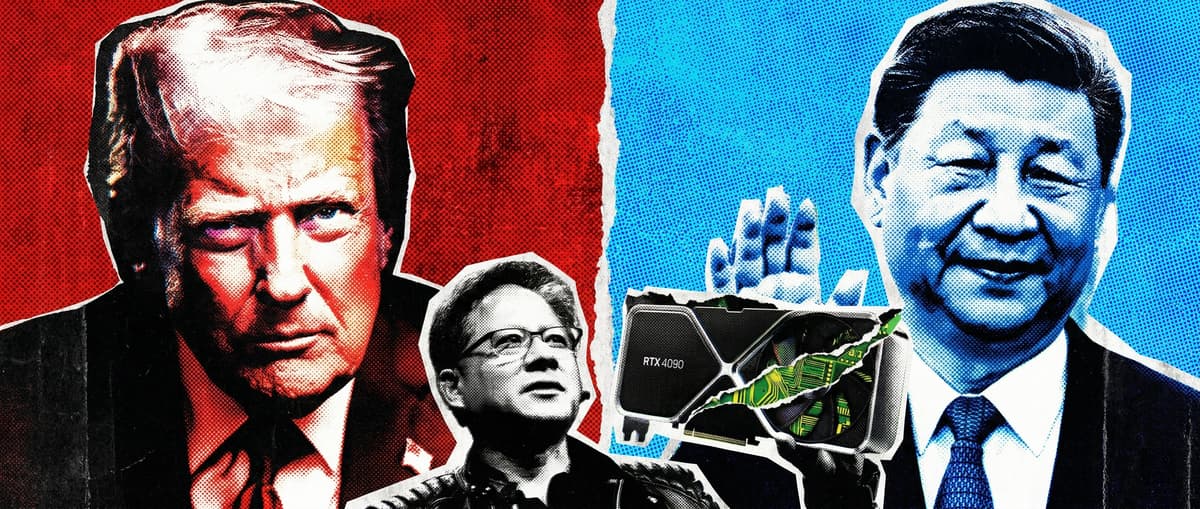
This week the news split into two totally different conversations. Business channels talked about U.S. export rules—basically the government saying Nvidia can sell fancy AI chips to China but has to give 25% of the money to Uncle Sam—and some Chinese company called DeepSeek releasing a new AI model. Gaming sites meanwhile were freaking out about RTX 5090s selling for $4,000 and the FBI arresting people for smuggling computer chips through Southeast Asia.
Nobody connected these stories. Which is weird, because once you line up when things happened, it's pretty obvious something doesn't add up.
What Happened (The Timeline)
October 2022: U.S. government says "you can't sell the really good AI chips to China." Specifically the A100 and H100 chips.
October 2023: China tries to get around this by buying slightly worse versions (A800, H800). U.S. says "nope, those are banned too."
November 5, 2025: China's government tells all their state-funded data centers "stop buying American AI chips, use Chinese ones instead." This is huge because state projects are where most of the money is.
December 8, 2025: U.S. says "actually Nvidia can sell H200 chips to China, but we want 25% of the sale price."
January 14, 2026: That 25% tax becomes official.
January 20, 2026: DeepSeek (Chinese AI company) releases their new model. Says they built it using those banned H800 chips everyone thought weren't good enough.
March 2026: FBI releases documents showing how people were literally gutting gaming PCs to smuggle AI chips through Malaysia and Thailand.
I kept staring at those November and January dates wondering if I'd screwed up reading them.
The Numbers (What This Actually Looks Like)
Nvidia's money last quarter: $68.1 billion (up 73% from last year)
How much profit Nvidia keeps: 71% of every dollar
Nvidia's share of China's AI market: Used to be 66%, now heading toward 8%
What it cost DeepSeek to train their AI: $6 million
RTX 5090 normal price: $1,999
RTX 5090 actual price right now: $4,000
Black market price for 8 high-end AI chips: $420,000 to $490,000
So Wait, What Happened Between November and January?
On January 14, 2026, the U.S. approved selling H200 chips to China with a 25% tax.
On November 5, 2025, China's government told all state-funded projects "don't buy American AI chips anymore."
Most of China's AI spending—we're talking about $100 billion worth of projects—comes from state-funded stuff. So the U.S. set up a tax to make money off sales to customers that China had already banned from buying the product.
Two months apart.
Was anyone checking what China's government was actually doing while negotiating this tax? Because this timing is just... really bad.
The DeepSeek Thing (Why It Matters)
Nvidia basically owns AI development because of something called CUDA. It's software that makes their chips work really well for AI. If you learn how to use CUDA, switching to different chips is a massive pain in the ass. So most companies just stick with Nvidia.
DeepSeek said "screw that" and programmed their AI at a much lower level—basically talking directly to the chip instead of using Nvidia's fancy software layer. They used 2,048 H800 chips (the ones that got banned back in October 2023) and trained an AI model that competes with stuff built on way newer, more expensive hardware.
Cost: $6 million. Results: just as good as models that cost way more.
When I first read their technical writeup, my brain basically went "wait, they did what with old banned chips?" The whole point of banning those chips was that you supposedly couldn't build competitive AI without the new ones. Turns out... maybe not?
What this demonstrates: cutting-edge AI development doesn't require cutting-edge U.S. silicon if developers write efficient code at lower abstraction levels. Hardware restrictions create workflow friction, not technical impossibility.
Why Your RTX 5090 Costs $4,000
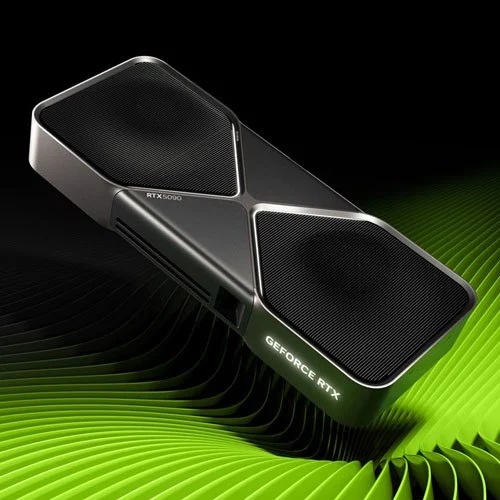
RTX 5090s have these things called tensor cores—basically parts of the chip designed for the same math AI training needs.
Here's what's happening: people who can't get the fancy enterprise AI chips are just buying gaming GPUs instead. They buy an RTX 5090, rip out the cooling system gamers need, slap on server fans, and rack them up in data centers.
Your gaming GPU. In a data center. Running AI models.
Normal price: $1,999. Actual price you'll pay: $4,000.
Now look, I can't prove 100% that this specific thing is the reason for the price gap—GPU markets are messy and companies don't publish "who bought our cards" breakdowns. But the FBI documents from March literally describe people gutting gaming PCs and modifying them for server use. And if you're treating a $2,000 gaming card as a substitute for a $50,000 enterprise chip, paying $4,000 makes total sense. The timing lines up too perfectly to be coincidence.
The Problem Nobody's Talking About
So let me get this straight:
- China banned their state projects from buying American AI chips (November 5)
- U.S. approved selling those chips with a 25% tax (January 14)
- DeepSeek showed you can build good AI on the old banned chips anyway (January 20)
What actually happened: Nvidia's China business dropped from 66% market share to maybe 8%. Chinese companies started buying from their own chip makers instead. And gamers can't find GPUs because they're all getting bought up and converted into AI servers.
Look, I get that chip export policy is complicated—there's national security stuff, diplomatic negotiations, lobbying, technical reports all happening at once. But this timeline makes it look like different parts of the government weren't even reading the same memos.
What The Government Thought Would Happen vs What Actually Happened
The government assumed:
- Chinese companies would keep buying U.S. chips even with restrictions
- Nobody could build good AI without Nvidia's CUDA software
- People would buy chips through official legal channels
What actually happened:
- Chinese state buyers just switched to Chinese chip makers after the November ban
- DeepSeek proved you can build competitive AI without CUDA if you're willing to code at a lower level (though we don't know yet if this works for everything)
- When official channels got blocked, people started buying gaming GPUs and smuggling enterprise chips
The whole tariff thing was set up without checking that China had already told their biggest customers not to buy the product.
Or maybe they knew and did it anyway for other reasons—sending a message to allies, politics back home, setting up future negotiations. Export policy is rarely just about the immediate sale.
My Take
The 25% H200 tax was supposed to make money off Chinese AI development while still selling them some chips. At least that's what it looks like on paper. In reality it hit three major problems—and honestly calling them "problems" is generous when they're really just the policy not matching what's actually happening in the real world.
Problem 1: The timing was awful. China banned their state-funded projects from buying foreign chips on November 5. The U.S. approved the taxed sales on January 14. That's like negotiating a deal to sell cars to a customer who already announced they're not buying cars anymore.
Problem 2: The technical assumption was wrong. The whole strategy banks on "you need the newest U.S. chips and Nvidia's software or you can't compete." DeepSeek's $6 million training run on old banned chips proved that's not necessarily true. If you can get similar results on last-gen hardware by writing better code, then the newest chips aren't mandatory—they're just easier to work with.
Real talk: I'm not an AI researcher, so I can't personally verify if DeepSeek's approach works for every AI use case. But their documentation is public, actual researchers have looked at it, and nobody's proven it doesn't work. That's enough to question the "you must have H200s to compete" narrative.
Problem 3: Markets adapt. When you block the official way to buy something expensive, people find unofficial ways. That's showing up in your GPU prices. RTX 5090s at $4,000 aren't expensive because of normal scalping—it's because buyers who need AI chips are buying gaming cards and converting them into server hardware.
The end result: Export rules aimed at enterprise AI chips are now messing up the consumer GPU market. Gamers and people building workstations are competing with buyers who can pay $4,000 for a card because they're using it as a cheap substitute for $50,000 enterprise hardware.
This wasn't supposed to happen. The export controls were meant to slow down Chinese AI development and make some tax money. What actually happened: China switched to their own chip makers, DeepSeek showed you can train good AI on restricted old chips, and PC gamers can't find GPUs.
The policy didn't stop the thing it was trying to stop (Chinese AI development). It caused a completely different problem (GPU shortage for normal people).
Is the GPU shortage entirely because of this export policy mess? Probably not—there's always regular scalping, actual gamer demand, crypto mining when that's profitable, supply chain stuff I'm not tracking. But the timeline is hard to ignore: enterprise chip restrictions get tighter, China bans state buyers from foreign chips, consumer GPU prices double. That's not a coincidence.
The government set up a tax deal for a market that had already moved on. The GPU shortage is what's left over from that miscalculation.
At least that's how it looks from out here. Maybe there's classified intel or diplomatic reasons that make the timing make sense. Export policy involves information regular people don't have access to. But based on what's public—the dates, the sales numbers, the DeepSeek technical proof—this looks like a policy designed for a market that stopped existing before the policy even started.
Sources
Where this info came from: U.S. Bureau of Industry and Security export rules, Nvidia's official earnings reports, FBI court documents (Operation Gatekeeper), DeepSeek's R1 technical writeup, China's State Council announcements, GPU price tracking sites (PCPartPicker, StockX, Newegg), reporting from Reuters and Bloomberg on black market pricing
Note: Black market prices came from FBI court documents and investigative journalism. China's November ban timing confirmed through official government announcements and reporting by South China Morning Post and Caixin.
What I Couldn't Verify
- The exact percentage that Nvidia's China market share dropped from 66% to 8%—this is based on analyst estimates from multiple sources, not official Nvidia disclosure
- Whether all RTX 5090 price inflation is exclusively due to data center conversion—there's definitely demand from actual gamers too. But the scale of the price jump suggests significant data center demand is a major factor
- The complete scope of the GPU smuggling operation—FBI documents provide examples and estimates, but determining the total volume is difficult without access to full customs data
- Whether DeepSeek's approach scales to all types of AI training tasks equally well—their success on their specific model doesn't guarantee it works for all workloads. This is still being tested by other researchers
- The precise timeline of coordination between U.S. export policy teams and intelligence about China's November ban—this requires classified information access