
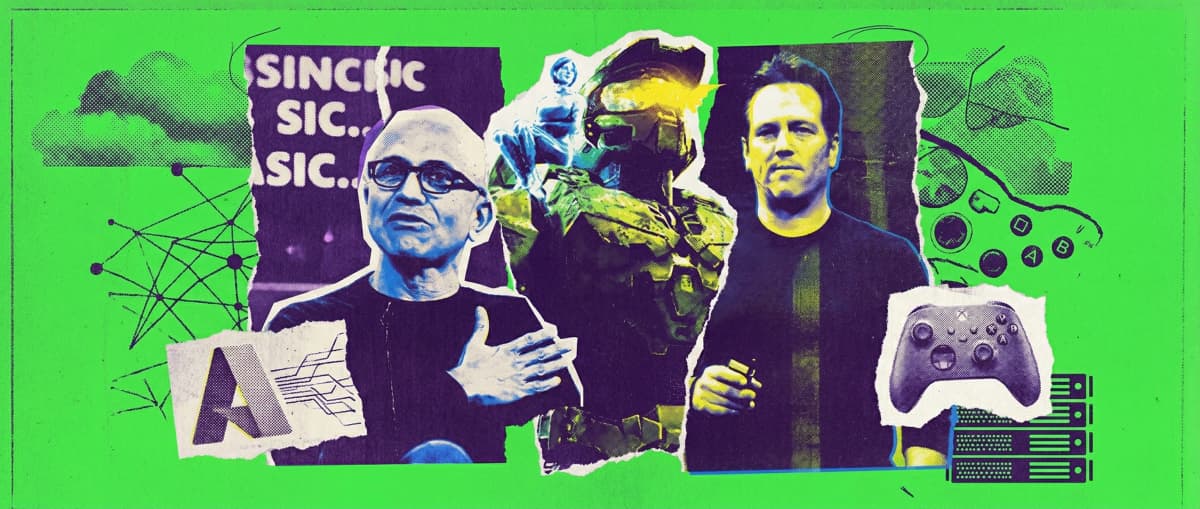
Glenn Israel worked on Halo for 17 years. Art director. ODST, Reach, 4, 5, Infinite. On April 4, 2026, he posted on LinkedIn accusing senior Halo Studios representatives and Microsoft of blacklisting, fraud, coordinated harassment, and violating Washington State law. The post is specific, cited, and apparently months in the making.
This is what we know, what holds up, and what doesn't, from both directions.
What Israel Claims, Specifically
Between January 2024 and June 2025, Israel says he witnessed firsthand or was personally subjected to blacklisting, fraud, rampant favoritism and cronyism, and multiple harassment campaigns designed to provoke the constructive discharge of employees otherwise in good standing.
Constructive discharge is a legal term. It means deliberately making conditions unbearable so someone resigns. Washington State prosecutes it as wrongful termination. He cited the statute by number.
After filing documented complaints with Microsoft HR in June 2025, Israel says a senior Global Employee Relations representative threatened retaliation on first contact and promised to shut down any further investigation. Internally escalated complaints were later reported as closed despite being returned as out of scope.
A four-day harassment campaign followed in July 2025, intended, he alleges, to manufacture grounds for termination. Microsoft's Business Conduct and Compliance department and Workplace Investigation Team had full visibility and failed to act. His role was declared "redundant" in September 2025, following what he describes as the catastrophic mismanagement of Halo Campaign Evolved. He also alleges Microsoft violated Washington State law RCW 49.12.250, which requires employers to give employees access to their own personnel files.
He closed with:
"I have the evidence. You are not safe."
The Case for Taking This Seriously
Former executive business administrator Robyn Cain, who left Halo Studios in May 2025, responded publicly:
"Halo equals harassment and retaliation."
She confirmed she witnessed it and it happened to her personally. Former content producer Tyler Davis, nine years at the studio, wrote:
"[Management] did a lot of us dirty to cover some f*** ups."
"There are those who wanted to fire every single artist, and they told me that bluntly."
Two former employees. Independent. Within hours. No apparent coordination, and neither had anything to gain.
In November 2022, Microsoft's own commissioned transparency report found a perception among some employees that the company tolerates and to some degree protects high-performing senior executives who may be engaging in inappropriate conduct, and noted that due to the volume of complaints against certain Corporate Vice Presidents, there was at least a perception and a degree of evidence that they were engaging in inappropriate conduct.
That's Microsoft's own hired law firm saying that in writing. Not a disgruntled employee. Not a leak. A report commissioned by the board following a 78% shareholder vote.
In response, Microsoft committed to implementing an auditing process to ensure discipline is enforced and that HR follow-up occurs, specifically to make sure complainants would not fear negative consequences, with a deadline of March 31, 2023.
Israel says GER threatened him in June 2025. Over two years after that deadline. The reforms either worked or they didn't. Microsoft's five-word statement doesn't clarify which.
A law firm, Sanford Heisler Sharp McKnight, is already investigating potential wrongful termination, discrimination, and retaliation claims against Microsoft related to its 2025 layoffs, noting that layoffs made in the name of operational efficiency can mask violations of employment law.
The Case for Skepticism, Applied Equally
Now the other direction. Because there is one.
Israel was present at 343 during one of the most publicly embarrassing moments in Halo's recent history. The 2020 Halo Infinite gameplay reveal was so poorly received that developers described the internal production as "four to five games being developed simultaneously," with conflicting creative direction and nearly half the studio comprised of contractors cycling in and out every 18 months due to Microsoft policy. That trailer produced the Craig meme. Israel has since clarified that he was not serving as art director at that stage — his role was within the concept art department, where the broader studio dysfunction was, by his account, opaque from the inside. He has not publicly addressed the visual failures of that reveal beyond that clarification.
The constant movement of talent and workers interrupted Halo Infinite's six-year development cycle on many occasions, amplifying mismanagement, scope creep, and the COVID-19 disruptions that hit the studio. The question of who holds responsibility for the visual failures of a game, the director who led creative decisions or the management that constrained them, is genuinely not settled. Israel's account positions him entirely as a victim. Studios rarely work that cleanly.
His post is also carefully written. Very carefully. Named departments, specific statutes, tight legal framing. That either means someone who kept meticulous records over 18 months, or someone who had months of post-employment time, possibly with legal counsel, to construct a maximally defensible public narrative before anyone could respond. Both things can be true simultaneously. Careful preparation and truthfulness are not mutually exclusive. But precision in presentation is not the same as precision in fact.
It is also worth noting that as of this writing, no lawsuit has been filed. No independent verification of any specific incident exists. The four-day campaign, the GER threat on first contact, the HR closures, those are all Israel's account. One person's account, filed on LinkedIn, not in a courtroom. That matters, even when the surrounding context makes it plausible.
Some observers have noted that questions around Israel's own role in the studio's creative output deserve acknowledgment alongside the workplace allegations. Seventeen years is a long time to be at a place that was, by many external accounts, dysfunctional for much of it. The line between surviving a broken culture and contributing to one is rarely visible from outside.
What the Record Around Him Actually Shows
Following the January 2023 layoffs, former 343 multiplayer designer Patrick Wren said publicly:
"The reason for both the layoffs and Halo Infinite's state is incompetent leadership up top during development, causing massive stress on those working hard to make Halo the best it can be."
Wren is describing leadership, not art direction specifically. But Israel was senior leadership. So.
Multiple developers described 343 Industries as a company split into fiefdoms, with every team jockeying for resources and making conflicting decisions, with one developer calling the process:
"Four to five games being developed simultaneously."
Art directors don't work in a vacuum. They also don't get credit only for what goes right.
Microsoft's Side, Such as It Is
Microsoft's statement was:
"Out of respect we don't publicly discuss individual employee issues, but we do take all claims seriously for both current and former employees."
That is not a denial. It is not a counter-account. It is not documentation. It is a sentence designed to exist, generate no follow-up questions, and close no loops. Corporations do this when litigation is possible or when the internal record is worse than the public statement would be. It is also sometimes what you say when you genuinely cannot comment while an internal review is underway. Both options remain open.
What Microsoft could do, if the account is inaccurate, is show internal records demonstrating Israel's role was made redundant through a process predating his HR complaints. They could show the complaint was properly investigated. They could confirm or deny whether a GER representative threatened retaliation and what action was taken against that person. The general legal logic of layoffs is that declaring a role redundant creates less legal exposure than direct termination, because you're not firing someone for poor performance, you're eliminating the position, which sidesteps documentation requirements entirely. Israel is alleging that's exactly what happened here. Microsoft isn't arguing otherwise publicly.
The Number That Doesn't Need Context
Of the nine people credited in the art team section of Halo Infinite, only one remains at the studio.
That's it. Nine people. One left. You can argue about why each individual left. You can argue about performance, creative differences, natural attrition, and industry turnover. You could probably build a reasonable-sounding explanation for any three of those departures in isolation. Explaining all eight simultaneously, during a period when a former developer is citing statutes on LinkedIn, is a different exercise.
Where This Actually Lands
Israel may be entirely right. He may be partially right. He may have experienced real retaliation and also be a less-than-perfect narrator of his own role in the studio's dysfunction. Microsoft may have genuinely tried to fix its HR systems after 2022 and failed, or may have never tried seriously. The departures, the 2022 transparency report, the corroboration, and the legal inquiry into the 2025 layoffs don't prove his specific claims. They do make it much harder to dismiss them as the grievance of one disgruntled senior employee.
What's clear is that Microsoft has produced a statement containing no actual content, and Israel has produced a post containing quite a lot of it. Only one of those positions gets harder to hold as time passes.
He said:
"You are not safe."
Microsoft said they take it seriously. One of those things requires no evidence to say.
All allegations are Israel's claims and unverified as of publication. Microsoft declined to address specific allegations publicly. Sources: Glenn Israel LinkedIn (April 4 and October 2025). GamesRadar, The Gamer, Windows Central, NotebookCheck, TwistedVoxel, Insider Gaming, PCGamesN, VGC (April 2026). Jason Schreier/Bloomberg, Escapist, Game Developer, 80.lv, Lords of Gaming (2021–2025). Microsoft Transparency Report (November 2022). Microsoft action plan (November 2022). Sanford Heisler Sharp McKnight investigation page (2025). MobyGames (Israel credits).